Property companies made up one in six pre-Budget MVLs. The data cannot explain why
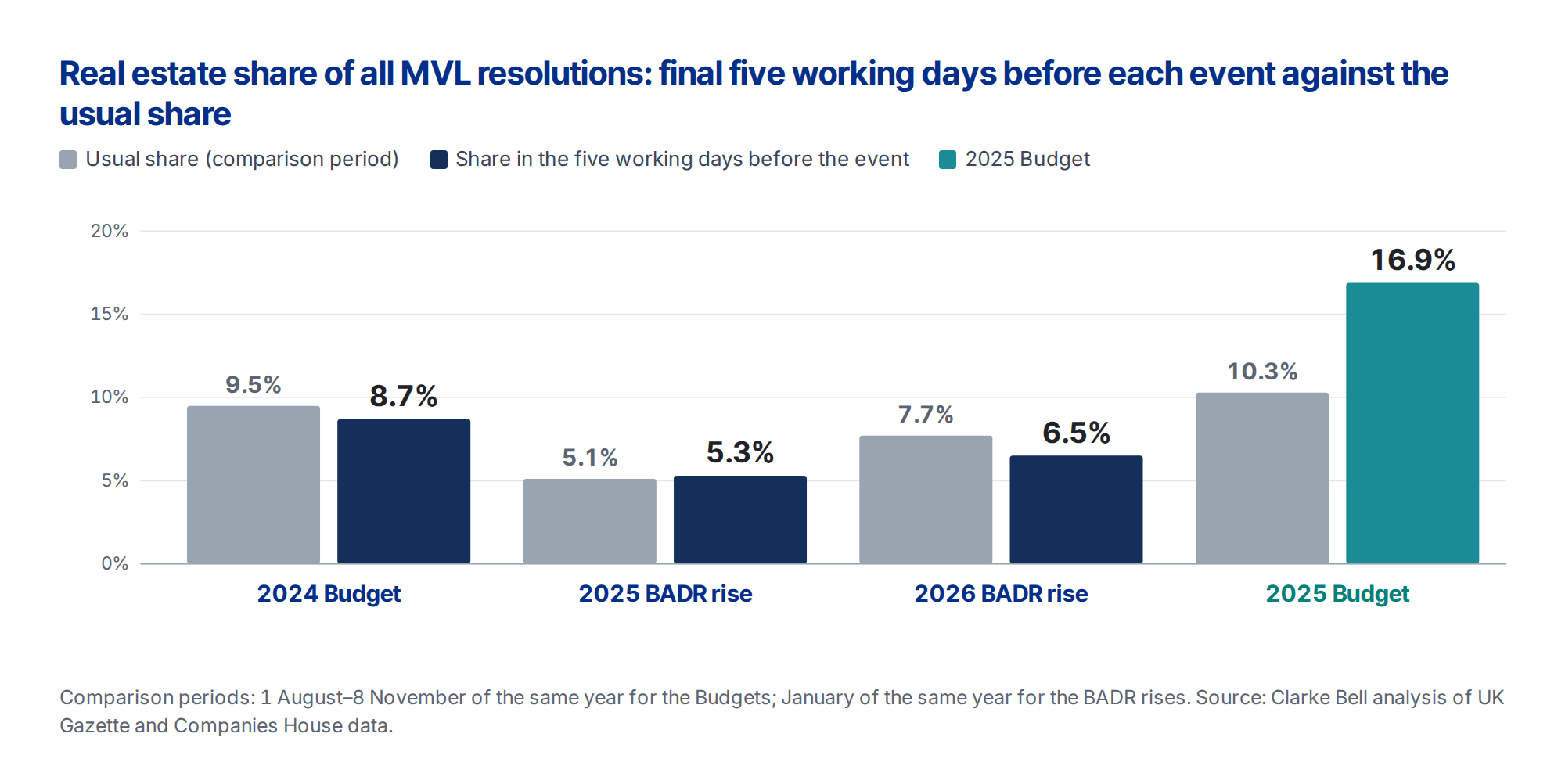
Real estate companies accounted for 16.9% of UK members’ voluntary liquidation resolutions in the five working days before the November 2025 Budget, compared with a usual share of 10.3%. The timing is striking, but the data cannot establish why individual shareholders acted.
Property companies accounted for 54 of the 319 UK members’ voluntary liquidation resolutions recorded in the five working days before the November 2025 Budget, according to analysis supplied to Property Business Insights.
The analysis was supplied by Clarke Bell, a Manchester-based firm of licensed insolvency practitioners that provides Members’ Voluntary Liquidations and other company-closure services.
That represented 16.9% of the national total between 19 and 25 November 2025.
Across Clarke Bell’s comparison period—1 August to 8 November 2025—real estate companies accounted for 145 of 1,414 resolutions, or 10.3%.
The pre-Budget share was therefore 6.6 percentage points higher than usual, equivalent to an increase of about two-thirds. It is a notable concentration, but it is not evidence that the Budget caused those decisions.
These were solvent closures, not business failures
A members’ voluntary liquidation, normally shortened to MVL, is a procedure through which the shareholders of a solvent company appoint a licensed insolvency practitioner to wind it up and distribute its remaining assets.
The company must be able to pay its debts, normally within 12 months. An MVL should not be confused with an insolvent liquidation, nor treated as evidence that the company failed or that its underlying properties were sold.
The figures in this study concern company resolutions. They do not measure insolvencies, distressed property sales or changes in the number of landlords operating in the market.
A break from the previous pattern
The same analysis compared the real estate sector’s normal share of MVLs with its share immediately before four fiscal events.
Ahead of the 2024 Budget, real estate represented 8.7% of resolutions during the final five working days, against a comparison-period share of 9.5%.
Before the 2025 increase in Business Asset Disposal Relief rates, its share was 5.3%, compared with a usual 5.1%. Ahead of the 2026 increase, the corresponding figures were 6.5% and 7.7%.
Those earlier events show the sector moving broadly in line with its established share. The November 2025 Budget is the clear exception in the supplied analysis.
Real estate share of all MVL resolutions in the final five working days before each event, compared with its usual share. Comparison periods were 1 August to 8 November for Budgets and January for BADR changes. Source: Clarke Bell analysis of UK Gazette and Companies House data.Chart figures
This makes the timing worth reporting. It does not reveal the motive behind any individual resolution.
What the data cannot tell us
The underlying records identify the companies, their resolution dates and their registered industrial classifications. They do not record why shareholders chose to close a company or why they acted on a particular date.
Tax planning, retirement, succession, portfolio restructuring and the completion of a company’s purpose can all form part of an MVL decision. The dataset cannot distinguish between them.
The November 2025 Budget was preceded by discussion about the tax treatment of property income and gains. The Budget subsequently announced separate rates for property income, but that wider context is not proof that the prospect of a tax change caused any particular shareholder to act.
John Bell, senior partner and licensed insolvency practitioner at Clarke Bell, said:
“The data can't tell us why any individual shareholder acted, but the context is hard to ignore.”
That is an appropriate interpretation of the result: the pattern is unusual enough to examine, but the research supports correlation rather than causation.
The companies were generally long established
The wider dataset contains 1,915 real estate MVL resolutions between January 2024 and September 2026. Clarke Bell states that these relate to 1,915 distinct company numbers.
The 54 real estate resolutions recorded immediately before the November 2025 Budget also relate to distinct company numbers.
Companies classified as letting their own or leased real estate had a median age of 21.9 years at resolution. The median was 19.4 years for real estate companies generally and 12.1 years across all MVLs in the analysis.
This suggests the property cohort included many mature companies rather than only short-lived corporate structures. It does not, by itself, establish why they were wound up.
The 2025 figures may encourage company owners to examine their options before this year’s announcement. However, the research does not support making decisions in response to speculation alone.
Bell said:
“With another Budget approaching, anyone running a property company and thinking about a solvent closure should take advice on their own circumstances rather than react to speculation.”
Business Asset Disposal Relief can apply in defined circumstances, but eligibility depends on the company, the shareholder and the structure of the disposal.
How we checked the figures
Clarke Bell supplied Property Business Insights with its methodology note, calculated data tables and record-level verification data.
The record-level file contained company numbers, resolution dates, SIC codes and links to the originating Gazette notices.
Where a company had more than one notice within the same UK tax year, the researchers retained the earliest resolution and used the lower Gazette notice ID to resolve ties. Group notices were counted once under the lead company’s number.
Property Business Insights checked the calculations presented in the supplied workbook and spot-checked a selection of records against their Gazette notices. We did not independently recreate the complete national dataset from source.
September 2026 figures in the wider study are provisional. Industrial classifications rely on Companies House SIC records and may not describe every company’s complete activities.
The research cannot identify the reason for an MVL or prove that a fiscal event caused an individual decision.
Disclosure
Clarke Bell, which provides paid MVL services, supplied the research and supporting files through its marketing agency, Exposure Ninja. Property Business Insights received no payment for publication. Neither organisation was given editorial control or approval over this article.
No public URL for the complete research or methodology was available at publication.