Liverpool is England and Wales’ most affordable sizeable new-build market
PBI’s first New-Build Affordability Index compares 305 local authorities using official prices, earnings and sales evidence, with confidence thresholds to prevent thin markets driving the headlines.
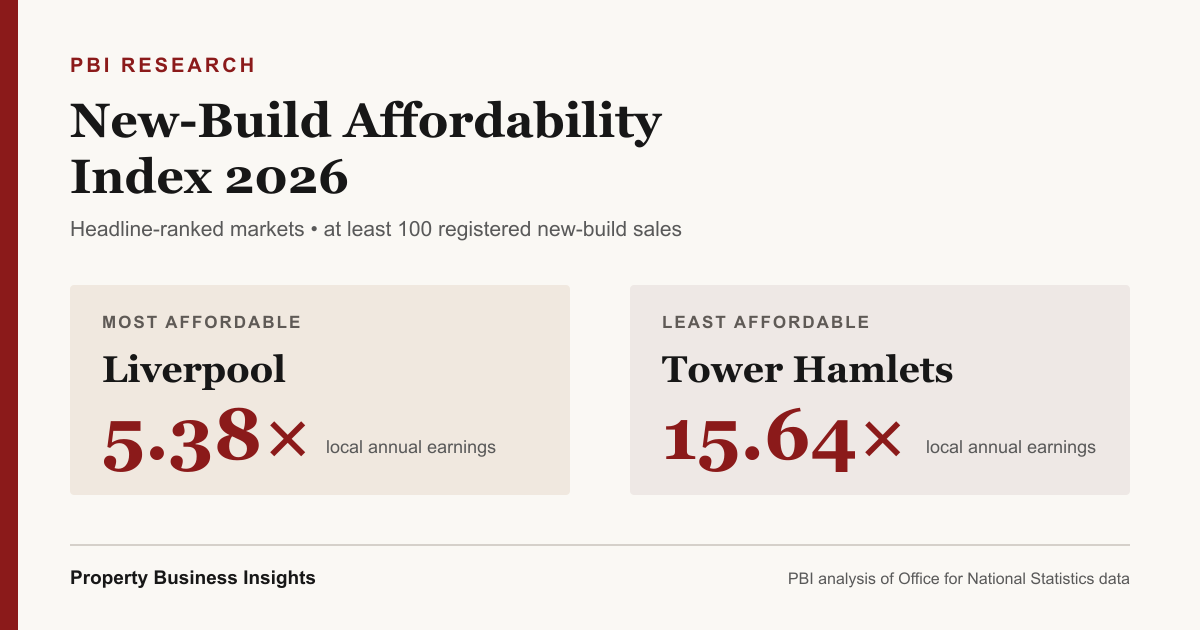
Liverpool and Tower Hamlets sit at opposite ends of PBI’s headline ranking. Source: PBI analysis of Office for National Statistics data.
Liverpool was the most affordable sizeable new-build market in England and Wales in 2025, while Tower Hamlets was the least affordable, according to a new local-authority index produced by Property Business Insights.
The PBI New-Build Affordability Index compares the median price paid for a newly built home with median gross annual full-time earnings for residents of the same area. It combines official price and pay figures with transaction volumes, so areas with very few sales do not drive the main rankings.
Liverpool leads the most affordable group
The median newly built home sold in Liverpool for £199,998 in the year ending September 2025. That was 5.38 times median residence-based full-time earnings. Cumberland followed at 5.59, Stoke-on-Trent at 6.01, Salford at 6.33 and Middlesbrough at 6.40.
The ranking is not a claim that every development in those places is cheap. New-build prices can move sharply with the type, size and location of homes completed during a year. The sales threshold is intended to reduce that distortion, not eliminate it.
London contains both extremes
Tower Hamlets had the highest eligible ratio at 15.64, followed by Camden at 15.58 and Brent at 14.24. Tonbridge and Malling and North Hertfordshire completed the five least affordable headline-ranked markets.
London also demonstrates why local evidence matters. Bromley’s ratio of 6.71 was the lowest among the capital’s headline-ranked markets, creating a much wider spread than a single regional average can show.
The national ratio improved, but the burden remains high
Across England and Wales, the official new-build ratio decreased by 0.25 points from 9.34 in 2024 to 9.09 in 2025. That is an improvement in the relationship between prices and earnings, although it does not include deposit requirements, interest rates, mortgage terms, service charges or buyer incentives.
The regional series placed the North East at 7.62 and London at 11.62. PBI uses those official regional observations rather than averaging local-authority ratios, which would give equal weight to markets of very different sizes.
Why PBI added confidence bands
Local new-build markets can be thin. A small number of premium flats or larger family homes may materially change a median. PBI therefore divides the 305 publishable authorities into three evidence bands.
Headline ranked: at least 100 registered new-build sales; 149 authorities.
Indicative: 50 to 99 sales; 70 authorities.
Low volume: fewer than 50 sales; 86 authorities.
Every publishable authority remains available in the interactive table and canonical CSV, but only the first group is used for the national top and bottom claims.
Explore and reuse the evidence
The full index lets readers search all 305 authorities, filter by region and evidence strength, compare new-build prices with existing homes, and download the underlying local-authority data and publication-ready charts.
PBI divided the Office for National Statistics median price paid for a newly built dwelling by median gross annual full-time residence-based earnings. The underlying price and sales period is the year ending September 2025; earnings are for 2025. Published ONS ratios were independently checked against their price and earnings components. Separate ONS existing-home data supplies the new-build premium comparison.
The measure is a relative affordability indicator, not a mortgage-eligibility calculation. It does not control for household income, deposits, financing costs, incentives, shared ownership, service charges, property size or the mix of homes sold.
Source notes
This article was written from the trade reporting below. The analysis and the PBI Take are ours; we have not independently verified the underlying facts.